 Culture
SpaceX Starship V3 Soars in Critical Flight Test
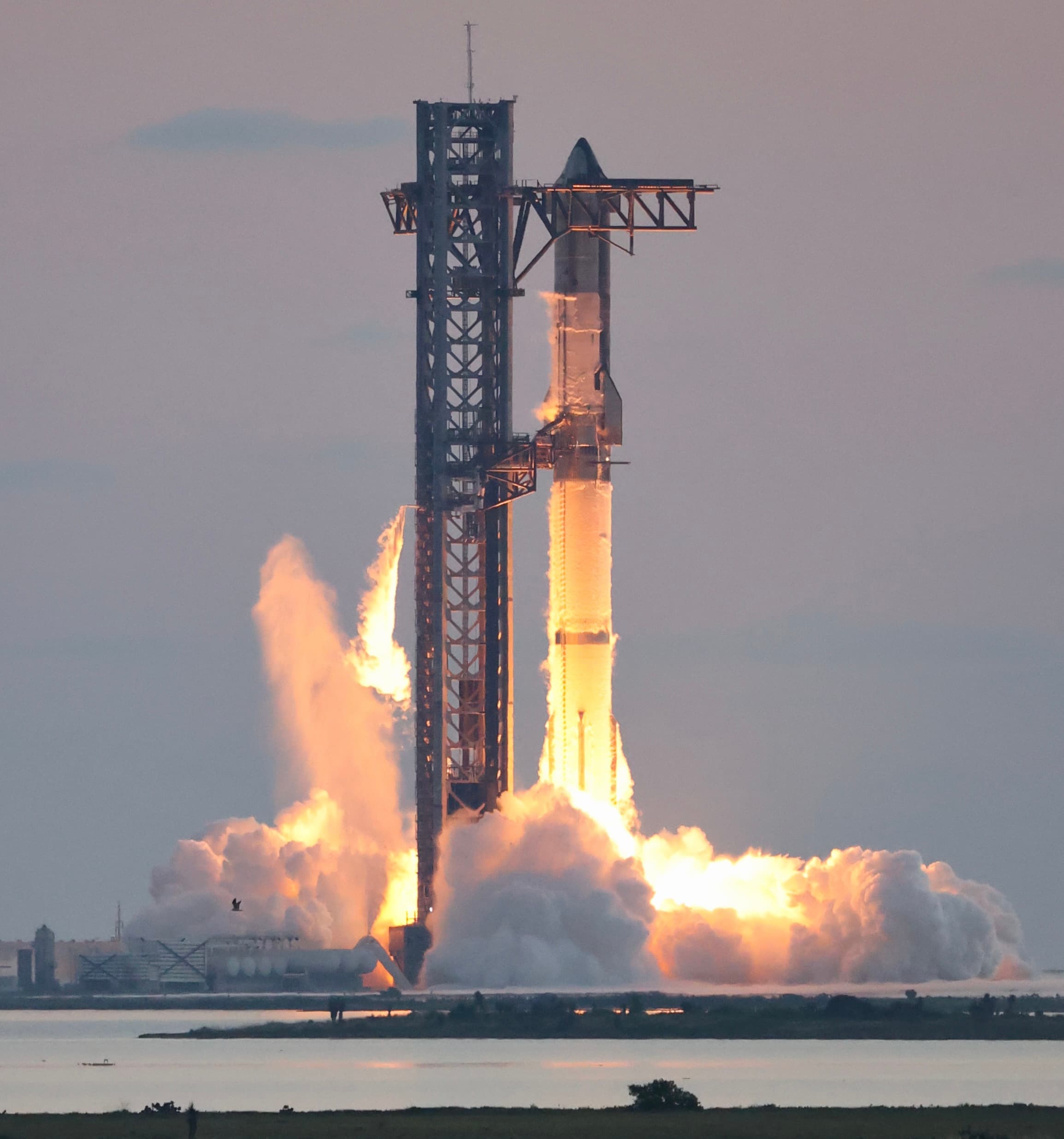
SpaceX just took another giant leap for space exploration. The company's massively upgraded Starship Version 3 (V3) system successfully completed its twelfth integrated flight test, marking a crucial step forward for the most powerful rocket ever built. After months of anticipation and several launch scrubs, the colossal vehicle finally soared from its Texas launchpad, pushing the boundaries of what's possible in spaceflight.
The monumental Flight 12 mission launched on Friday, May 22, 2026, from SpaceX's Starbase facility in Boca Chica, Texas. This launch was particularly significant as it introduced the Starship V3, a version boasting substantial enhancements designed to revolutionize space travel. The liftoff, initially set for 6:30 p.m. EDT (5:30 p.m. local time), reportedly experienced a slight delay before the massive rocket ascended into the sky.

The mission saw the Super Heavy first stage booster execute a controlled splashdown in the Gulf of Mexico, approximately seven minutes after launch. Meanwhile, the Starship upper stage, often referred to as Ship, continued its planned trajectory, ultimately splashing down in the Indian Ocean off Western Australia about 65 minutes post-liftoff. This successful flight was the first Starship mission of 2026, coming seven months after the preceding Flight 11, underscoring a renewed pace in the ambitious development program.
The path to Flight 12 was not without its challenges. The launch sequence faced multiple delays, initially targeted for Tuesday, May 19, 2026, then successively pushed to Wednesday, May 20, and Thursday, May 21. The attempt on Thursday was ultimately scrubbed in the final minutes before liftoff due to technical issues. SpaceX CEO and CTO Elon Musk publicly reported on X that "The hydraulic pin holding the tower arm in place did not retract," adding, "If that can be fixed tonight, there will be another launch attempt tomorrow at 5:30 CT." This issue led to the final rescheduling for Friday.
During the live webcast of the successful launch, SpaceX Communications Manager Dan Huot acknowledged the complexities of the new systems. "New rocket, new pad, we're learning a lot about these new systems as we execute them for the first time," he stated, expressing optimism for future attempts by noting, "We are expecting to be able to make another flight attempt tomorrow." This sentiment highlights the iterative and learning-intensive nature of Starship's development.

The V3 design itself incorporates a suite of significant upgrades. These include stronger and lighter Raptor engines, a redesigned fuel system, improved heat shield protection, and enhancements specifically for rapid satellite deployment. The rocket is engineered to eventually transport an impressive 100 metric tons to low-Earth orbit. The primary goals of this flight test were to rigorously demonstrate these new components in a real flight environment, with each part of the Starship architecture undergoing substantial redesigns aimed at achieving full and rapid reusability.
Previous integrated flight tests have been instrumental in this development. IFT-3, on March 14, 2024, notably demonstrated propellant transfer but also encountered issues like engine shutdowns during boostback burns due to filter blockages. IFT-4, launched on June 6, 2024, focused on proving the ability to return and reuse both Starship and its Super Heavy booster, with objectives for a soft splashdown of the booster and controlled entry of the Starship. IFT-5, on October 13, 2024, marked the first attempt to catch the Super Heavy booster with the launch tower's mechanical "chopstick" arms, a daring maneuver central to SpaceX's rapid reusability vision.
The successful launch garnered significant praise from the space community. Isaac Arthur, president of the National Space Society, lauded the achievement. "Today's successful test is a remarkable achievement for SpaceX and for humanity's ambitions in space," Arthur remarked, adding, "Each flight of Starship moves us closer to fully reusable, large-scale spaceflight, which will be essential for returning astronauts to the Moon, establishing a presence on Mars, and settling the solar system."
Don Platt, director of the Spaceport Education Center at Florida Tech, also underscored the test flight's critical importance. He stated, "It is absolutely critical... There's no reason to have an Artemis III if there's not at least a Starship or Blue Origin lunar lander that is..." His comments highlight the pivotal role Starship plays in broader national space objectives.
This flight holds immense importance, especially given Starship's integral role in NASA's Artemis program. The colossal rocket was selected in 2021 to serve as the human landing system for the Artemis III mission, which aims to return astronauts to the Moon for the first time since the Apollo era. It was subsequently chosen for Artemis IV as well, solidifying its place in the future of lunar exploration. The Artemis III mission is currently slated for September 2026, with NASA Administrator Bill Nelson previously indicating close monitoring of Starship's development.
Beyond lunar missions, Starship is also being developed with the ambitious long-term goal of transporting humans to Mars, envisioning a future where humanity becomes a multi-planetary species. Specific objectives for Flight 12 included testing stage separation, booster recovery systems, reentry performance, engine relight capability, and payload deployment operations. During this test, the Starship upper stage deployed 20 Starlink simulators, which are similar in size to next-generation Starlink V3 satellites, along with two specially modified Starlink satellites. These modified satellites were designed to test hardware for Starlink V3 and to scan Starship's heat shield, transmitting imagery to operators for analysis of heat shield readiness for future return-to-launch-site missions. Notably, a single heat shield tile was intentionally removed to measure aerodynamic load differences on adjacent tiles during reentry, providing crucial data for future design improvements. Unlike some previous tests, the Super Heavy booster did not attempt a return to the launch site for a catch by the launch tower's mechanical arms, instead executing the controlled splashdown in the Gulf of Mexico.
The extensive development process for Starship has had its commercial impacts, too. The "Dear Moon" mission, purchased by Japanese billionaire Yusaku Maezawa in 2018, was ultimately abandoned in 2024 due to the prolonged development timeline, a testament to the sheer scale and complexity of the project. Despite this, SpaceX continues to aggressively expand its infrastructure, constructing new Starship launch, production, integration, and test facilities across Texas, Florida, and California, signaling a clear commitment to its grand vision for space. Each successful flight, like Flight 12, brings that vision closer to reality, paving the way for a new era of human spaceflight and exploration.