 Culture
Starship V3 Grounded After Debut Flight Mishap
SpaceX's ambitious Starship program hit a snag just days after its latest vehicle, the Starship and Super Heavy Version 3, made its highly anticipated debut. The U.S. Federal Aviation Administration (FAA) has declared the Starship Flight 12 launch a "mishap" and ordered a full investigation, effectively grounding the cutting-edge megarocket.
The grounding came on May 27, 2026, a mere five days after the May 22 launch. The FAA's decision stems from the Super Heavy booster's "off-nominal performance" during the flight. While the Starship upper stage largely succeeded in its objectives, the booster's issues were significant enough to trigger the regulatory body's intervention. As part of the process, the FAA will oversee SpaceX's investigation, remain involved at every stage, and must approve the final report and any corrective actions before Starship can fly again. Crucially, no public injury or damage to public property was reported.
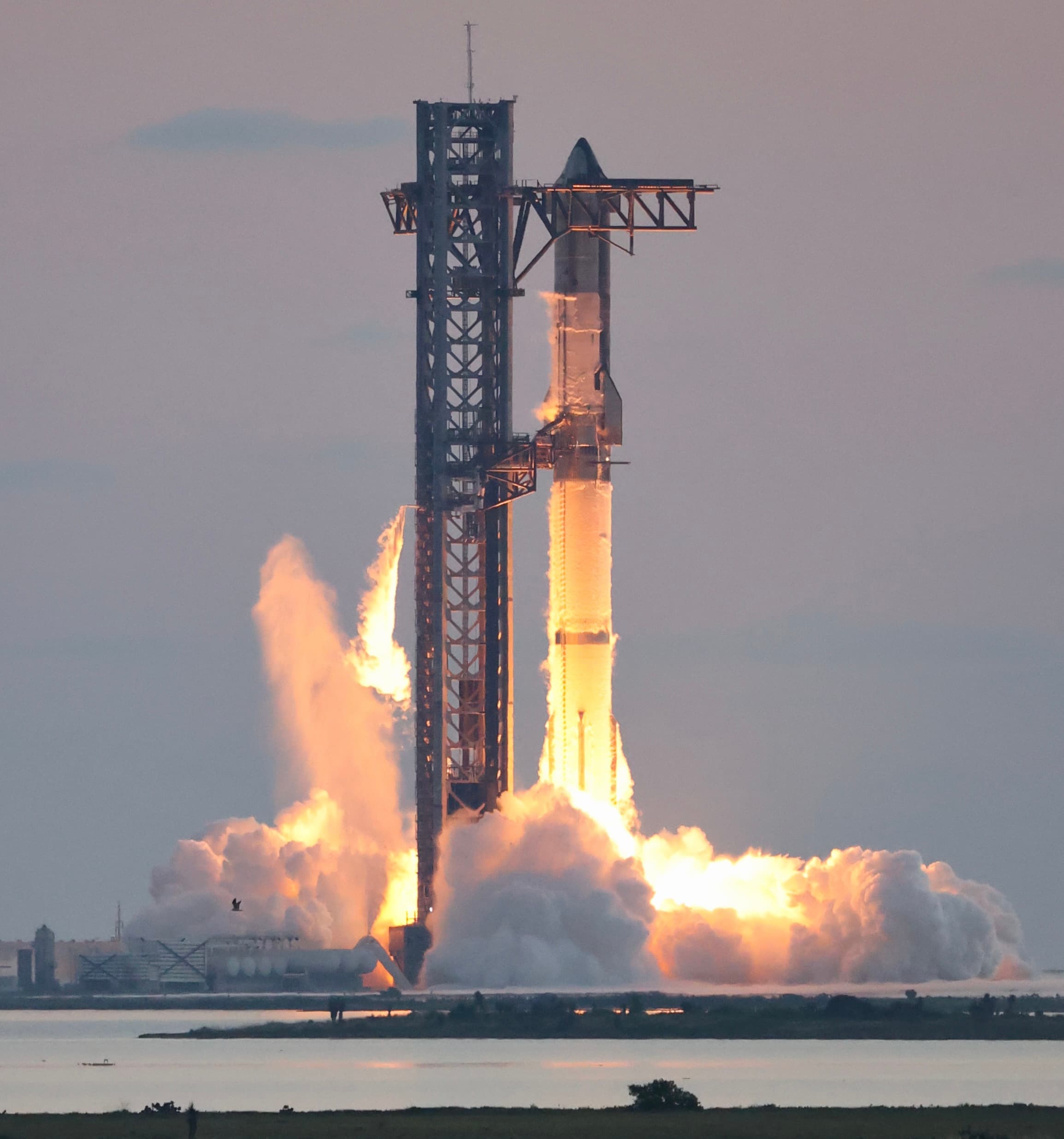
The Starship Flight 12 mission, which launched from SpaceX's Starbase facility in South Texas, was a landmark event. It marked the very first integrated test flight for the Version 3 vehicles, equipped with the new Raptor 3 engines and launching from the freshly completed Pad 2. The primary goal was to send the Starship upper stage on a suborbital path, perform a controlled atmospheric reentry, and splash down precisely in the Indian Ocean.
Originally scheduled for May 21, the launch was delayed due to a hydraulic pin problem on the ship's quick disconnect arm. It successfully lifted off the following day, May 22, at 5:30 p.m. CT (2230 GMT). During the ascent, one of the 33 Raptor V3 engines on the Super Heavy booster (tail number B19) unexpectedly shut down approximately one minute and 42 seconds into the flight. Less than a minute later, around the two-minute, 22-second mark, SpaceX began an intentional, staggered engine shutdown to prepare for stage separation, reducing the booster to five active engines.
Following the critical hot-staging maneuver, where Starship's upper stage (tail number S39) ignited its six Raptor engines to continue its journey to space, the Super Heavy booster faced further complications. It performed a directional flip but failed to ignite all planned engines for its boostback burn. SpaceX's broadcast graphics showed 12 of 13 center engines igniting at the two-minute, 32-second mark, but several outer ring engines did not light as intended. SpaceX communications team member Dan Huot noted during the broadcast, "We are not seeing as many booster engines ignited as we expected for boostback, but we are seeing six good engines on ship." He concluded, "It looks like we just had an early boostback shutdown." The booster then attempted a landing burn, but it resulted in a "hard splashdown" in the Gulf of Mexico, impacting the water at an estimated 1,450 kilometers per hour. Reports suggest that an explosion or rapid disassembly within one of the center engines during the relight sequence might have damaged adjacent Raptors.
Despite the booster's troubles, the Starship upper stage, S39, largely performed as planned. Even with one of its three Raptor Vacuum engines failing shortly after ignition during ascent, the vehicle successfully demonstrated its engine-out capability and maintained its intended trajectory. During its coast phase, Starship deployed 20 dummy Starlink internet satellites and two actual Starlink satellites, which were specially equipped with cameras to capture images of the vehicle's heat shield in space. These modified satellites were designed to scan the heat shield tiles to assess their condition before reentry. Starship then re-entered Earth's atmosphere, collecting vital data on its heat shield and structural integrity. It completed a stress test of its rear flaps and executed a dynamic banking maneuver, simulating future return trajectories back to Starbase. The upper stage concluded its mission with a landing flip and a landing burn using two Raptor engines, achieving a soft, controlled splashdown in the Indian Ocean as planned. After splashdown, the vehicle tipped over, and residual propellants mixed and ignited, creating a fireball, which was an expected outcome for the test vehicle.
This is not the first time the Starship program has faced FAA-mandated investigations. Similar assessments were conducted after the initial four launches of the Version 1 configuration, and three additional mishap investigations followed Flights 7-9, which utilized Version 2 rockets. Each grounding underscores the rigorous regulatory oversight of experimental spaceflight and the iterative nature of developing such complex systems.
The Starship program is central to SpaceX's long-term vision. It is engineered to be a fully reusable transportation system, capable of carrying more than 100 metric tons of cargo and crew to Earth orbit, the Moon, and ultimately Mars. Its success is pivotal for drastically reducing launch costs, expanding the Starlink satellite internet constellation, enabling future advancements like space-based computing, and facilitating human missions to other celestial bodies. NASA, in particular, has a vested interest in Starship's progress, relying on the vehicle to serve as the human lunar lander for its Artemis missions, which aim to return astronauts to the Moon.
Reactions to the flight were mixed, reflecting the dual outcome. SpaceX CEO Elon Musk took to X to commend his team, stating, "Congratulations SpaceX team on an epic first Starship V3 launch & landing! You scored a goal for humanity." He also highlighted a key success for the upper stage, tweeting, "No burn-throughs. Shield held," a significant achievement that contrasted with issues in previous Starship test flights. NASA Administrator Jared Isaacman, who witnessed Flight 12 from Starbase, also shared his optimism on X, posting, "Congrats SpaceX team and elonmusk on a hell of a version 3 Starship launch. One step closer to the Moon… one step closer to Mars."
The successful performance of the Starship upper stage, especially its heat shield, was indeed a major accomplishment, providing critical data for future development. However, the FAA's grounding means that further progress hinges on the thorough investigation of the Super Heavy booster's anomalies. The Starship-Super Heavy vehicle will remain on the ground until the FAA determines that any system, process, or procedure related to the mishap no longer poses a risk to public safety. The path to the Moon and Mars, while clearer for the upper stage, still requires the full stack to prove its reliability.